
Dominance and Submission pt. 3: The Powerful Man
- Wait, it's all about power? - Always has been

The Dominance and Submission series:
Part 3: The Powerful Man
In both previous parts I wrote about creating high-functioning and stable social relationships, which are ideally dominance/submission relationships with reinforcements such as social norms, narratives or egalitarian components.
All of this addressed the problem of creating a high-functioning society - a society that can collectively solve complex problems such as going to the moon, providing food and fresh water to every household or fending off the barbaric hordes storming the gates.
While such high-functioning society provides systems and institutions that meet many (if not most) individual needs, we all have specific individual needs that we need to take care of ourselves.
Some of our individual needs can only be met within relationships with other people. And in most cases, the effectiveness of having our needs met in a relationship corresponds with how dominant our position is:
A dom in a dominance/submission relationship can have most, if not all of their needs met.
A person in an egalitarian or a cross-dominance relationship can have some of their needs met, respectively by negotiation/consensus seeking or exerting their dominance in specific areas of the relationship.
A sub in a dominance/submission relationship will have most of their needs met only in a perfect dominance/submission relationship - a dream job, a perfect marriage, textbook parents. Those don’t happen very often, so realistically, most of sub’s needs are unmet. However, sometimes the needs the sub is having met in their relationship (i.e. financial or physical security) are far more important than the needs they’re not having met (i.e. emotional comfort), and they’re unable to have these important needs met otherwise.
Another way to put it is that in order to have your needs met in social relationships, you need power.
In physics, power is the capacity to perform work, for example to make things move. In social relationships, power is the capacity to make people move - or to make them do things they don’t want to do, or at least wouldn’t normally do on their own.
Acquiring power is what enables becoming a dom in dominance/submission relationships, reaching for more dominance in egalitarian and cross-dominance relationship, and getting out of the sub position in dominance/submission relationships by either removing some of the dom’s power (making the relationship more egalitarian) or gaining some power over him (moving into a cross-dominance relationship).
Power and status
We often say that people want status, or that women are attracted to high status men. But what we all actually want is power.
We want to be powerful, and we also want to be surrounded by other powerful people - especially if we have some power over them.
Status, on it’s own, is actually meaningless - it’s just a representation of power; a currency. Status and power are typically aligned, but whenever they’re not, weird and interesting things happen, like when a currency suddenly loses or gains value due to rapid inflation or deflation.
mentioned dominance and prestige as two strategies one can use to attain status:Dominance in humans is associated with narcissism, aggression, and disagreeableness. Under the dominance framework, status is attained by instilling fear in others through coercion, intimidation, and displays of brute force.
People (and animals) confer status to dominant individuals because of what the individuals can do to them. Inflict costs, pain, humiliation, injuries, disfigurement, violence, reputation destruction, and so on. Joseph Stalin obtained status through dominance.
The second type of status: Prestige. It is more evolutionarily recent and pervasive among humans.
Prestige is associated with stable self-esteem, social acceptance, being well-liked, and the personality trait of conscientiousness.
Prestige is freely conferred to individuals based on their knowledge, skills, or success. We confer status to prestigious individuals because of what these individuals can do for us. Provide benefits, teach useful things, grant access to resources, bolster our own status by being associated with them, and so on. Stephen Hawking obtained status through prestige.
This description also actually applies to power, not status. It’s true for status though if we assume status is aligned with power - most of the time, it is.
“Dominance”, as used above for capability to punish, is not the best word, as I tend to use it more to describe a position in a dominance/submission relationship. So from now on, let’s use “terror” instead of “dominance” in the above context.
Prestige and terror as two main sources of power correspond to two basic types of motivation: the carrot and the stick.
Unleashing power can make one’s life heaven, or hell. Heal, or kill. Make or break a business. Promise a reward, or threaten with punishment.
When people recognize power, they typically (but not always) confer status to the powerful one.
And this power can be used to become a dom in a dominance/submission relationship - even if it’s entirely based on prestige, not terror.
Power and credibility
Terror and prestige are not directly linked to power - the link is credibility.
To have power, it’s not enough for the people to know that you CAN punish or reward them - they have to know that you WILL punish or reward them. By losing credibility you can quickly lose power as well, even if you’re still technically able to punish or reward others.
Power and money
In a free-market economy, many people conflate money with status. This is because money, like status, is also a currency of power.
If you hand over a proper quantity of money to someone, they will do something for you they wouldn’t normally do otherwise, like provide you with some goods or services. This is basically the definition of power.
Of course, there are things money can’t buy - for these, you might other kinds of power (terror or prestige), but in the modern free-market economy, there is just not a lot of these things.
Many of us are disappointed with Western consumerism and materialism, but I think we don’t appreciate the fact how money can buy us almost anything. Fine dining, staying in luxurious rooms, driving fast cars, exotic fruit and seafood from the far corners of the world - in non-free-market societies, these things were only available to the kings and aristocracy, or their replacements such as the Supreme Leader and his Communist Party. Now, they’re available to basically anyone living in a modern Western country.1
Let’s look at some examples of how terror, prestige and money can be used to acquire power in some of the most common and important types of social relationships.
Power at work
At first glance, ascending in the pyramid-shaped dominance hierarchy by being promoted to more senior management positions is the way to acquire power in a corporate work environment.
However, a position in the pyramid is a marker of status, not power.
Sometimes, a low-level manager is essentially powerless, when he can’t do anything (hire/fire someone, make company expenses, or just run his business unit as he likes) without the approval from senior managers, HR or Finance.
On the other hand, people with actual power - the ones people seek advice or acknowledgement from - might be hidden within the organization. Former senior managers or technical leaders who decided to step down from their high-profile position, into an advisory or internal consulting role.
One way to gain power in an organization is fostering relationships with truly powerful people. Even a dominance/submission relationship with a powerful stakeholder in which you are the sub still provides with you some power that trickles down from the dom.
Neglecting visibility and power can be a costly mistake. A powerless low-level manager can find himself in a long-running conflict with low-performing employee. Eventually, the employee might accumulate enough power to bring HR and senior managers over to his side and turn the “he’s performance is poor and his attitude is horrible, so we have to let him go” case into a “my manager has turned against me and is bullying me” case.
But a powerful manager is resistant to that - even if his position does not grant him power, he has enough social power to always bring senior managers and HR on his side.
A powerful manager has both terror and prestige. He can punish employees by firing them, denying promotions or assigning bullshit, dead end jobs. He can also reward them by promoting them, assigning to the best project or a prestigious internal development program or saving them from being axed in mass layoffs. He can do this either by making decisions and enforcing them himself, or by subtly pulling the strings of the corporate procedures.
And the power of the most powerful managers extends well beyond the borders of their corporate realm. Throughout the years of intense networking and possibly working in different companies in the industry they have now contacts among clients, suppliers and competitors. They can leverage them for terror - send warnings to other companies to put the problematic employee on a blacklist, effectively ruining their career in the industry - or prestige - have someone hired elsewhere if they were laid off, or were stuck in a dead end job and moving to a different company is what’s best for them. 2
But you don’t have to be a senior manager to acquire this kind of power, both internal and external. An individual contributor can also acquire internal power that will open the gates and protect them from layoffs, as well as external power that will provide them opportunities within their industry for them or others they wish to reward. Yet, attaining such power is just easier for those who also managed to be promoted into high-status senior management positions.
Sometimes, an employee might also leverage his power to equalize their relationship with their boss.
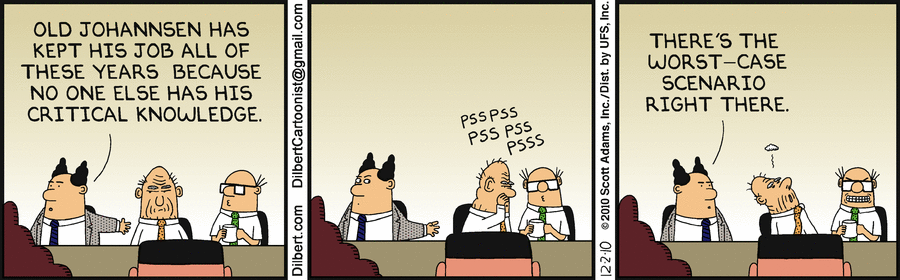
Being hard to replace - whether resulting from a hot job market or being a unique, experienced specialist (especially one with the “critical knowledge”) invalidates the boss’ power based on the terror of the threat of being fired.
Same thing happens if the employee has enough money - wealth or another source of income - that they don’t need their job to sustain their lifestyle. This invalidates the power based on prestige - money is less of a reward for someone who already has enough of it.
Both of these can shift the typical dominance/submission relationship between the boss and the employee towards a more egalitarian relationship, where both would need to negotiate or seek consensus in order to decide what to do. As mentioned in the first part, this is a low-functioning relationship from the perspective of the organization, but for the employee, it’s an optimal position where they can have more of their personal needs met.
Power in heterosexual relationships
The evolutionary reasons of power imbalance in heterosexual relationships were described in
’s recent essay:
These power imbalances result in physical hypergamy - both natural and nurtured preference for tall, big and strong men, which corresponded with their capability to provide and protect for most of our evolutionary history - and income hypergamy - a nurtured preference for high earning men, corresponding to their current capability to provide (and, to some extent, protect) in a modern free market economy.
Importantly, hypergamy affects male preferences as well. Men simply don’t want to date and marry a She-Hulk or a girlboss3.
For men, the optimal strategy in a relationship is to maximize their power. This provides them with a capability to get what they want from their relationship partner, increase their sexual attractiveness and social acceptance, and form a high-functioning dominance/submission relationship. A win-win-win.
As noted by
in his Stop Being Mean to Slutty Women essay, being an extremely powerful man is a prerequisite for extreme sexual submission:Being a “Tradwife” is sexy and glamorous among some cohort of Zoomer women because it stole a lot of aesthetics and concepts from the world of sugaring and laundered / sanitized them into a more domestic and “cozy” thing that appeals to low openness Republican types.
(…)
The idea of “Marital Debt” is basically Consensual Non-Consent in a sundress. It’s very 50 Shades, the sort of thing elites demand from their Kept Woman behind an ironclad NDA.
The thing is women in these situations don’t resent a CNC dynamic because they’re probably getting a six figure allowance and access to cool opportunities. They’re also high openness people who have a lot of options, as well as the verbal IQ to advocate for themselves even when dealing with Dark Triad CEOs and surgeons. They know what they’re doing.
(…)
But imposing something like “Marital Debt” on your 105 IQ low openness chubby wife when you’re a boring and mediocre guy who makes like $75k / year and lives in the suburbs is exceptionally fucked up.
This is especially the case if you expect her to sit at home with screaming toddlers all day changing shitty diapers. There is nothing glamorous about this and you’re not “providing” at a level that inspires real submission. In practice she will just feel like a human trafficking victim.
A man can increase his power in his relationship by improving different types of power: physical (strength & fitness), economical (wealth & income) and social (networking & connections).
In a way, power permeates between areas of life. Being a powerful manager, employee, father or friend contributes to being powerful in a heterosexual relationship. This is partially because being strong, competent, credible, wealthy and socially skilled helps with gaining power in any social relationship. 4
On the other hand, women trying to have their needs met in their relationship have to face several tradeoffs and conundrums.
First, power is a double-edged sword.
A powerful man can use his power to provide and protect his spouse - but he can also use it to terrorize her in order to have his needs met.
A common female fantasy is to find a dangerous, wild man and “tame” him such that he only uses his power against others, but never against her. This provides all benefits and no drawbacks of being with a powerful man. This is a very common trope in erotic fiction for female readers, including the most famous example, the 50 Shades of Grey series.
This scenario can work in real life, but it’s not for everyone, since the “taming” process puts a lot of strain on both partners5. In a fragile relationship, this strain might lead to a breakup.
Other, more universal solutions include a benefits vs risk optimization (trying to find a mid-power guy that will provide lots of benefits with little risk) and specifically screening for Dark Triad traits (narcissism, Machiavellianism, psychopathy).
Second, a woman trying to get more of what she wants in a relationship by increasing her power will not only make the relationship low-functioning (by making it more egalitarian), but also less socially acceptable and make both partners less sexually & socially attractive in the process.
This problem can be solved by either:
The “man is the head, but woman is the neck” dynamic - using Machiavellism to get what she wants while allowing him to believe he’s still in charge.
Transacting with sexual power. From
’s essay linked above:
Women were not powerless in this ancestral condition — far from it. Women had sexual power. They still have this power today. Arguably, a beautiful young woman is more powerful than any man. She can “launch a thousand ships”. Men are slaves to female beauty.
Becoming a fierce “gatekeeper of sex” until she gets what she wants can be an effective strategy. Overt transactions of sex for resources are rare, but it’s far more common for women to get angry (and thus “not in the mood for sex”) if a man fails or forgets to do something she wants - thus, conditioning him to perform the “right” behavior next time. Some even believe that all heterosexual relationships are transactional and based on exchanging female sexual access for male resources.
Some would argue that this is prostitution, but I would disagree. Prostitution and other types of sex work is what allows women to freely transact sexual power for resources outside of committed relationships. Technically, sex-positive feminists are right in that claim that sex-work is empowering.
The proliferation of sex work is what, I believe, is ruining the Western society, dating marketplace and fertility rates. A modern conservative system where women are only allowed to transact sexual power for resources in a monogamous marriage, sex is consensual (no martial rape) and sex work is not allowed or at least shamed, seems to be more high-functioning.
Creating a functional cross-dominance relationship. Cross-dominance relationships are usually low-functioning, because the roles and boundaries are not clearly defined. People get confused and argue about whether a thing belongs to their or their partner’s area of dominance, or whether an area is something they dominate in, or an egalitarian one where they should negotiate and seek consensus.
The solution is to properly compartmentalize all areas of the relationship, preferably such that all of them are dominated by the man or the woman - any egalitarian areas would be low-functioning due to the need to negotiate or seek consensus.Executive management - Can be used either to enhance a properly compartmentalized cross-dominance relationship, or a holistically as a version of the “man is the head, but woman is the neck” solution.
Corporate executives managing huge business units or entire companies obviously can’t micromanage everything that’s going on in their business. Instead, they have their subordinate senior managers create executive summaries with simple, concise information: the current state, the problem, the cost, the benefits, the risk, a recommended decision. They don’t need the details - they don’t care about how the sausage is made. The executive summary slides are reviewed in brief meetings, sometimes as short as 15 minutes, and in most cases the recommended solution is approved.
Here, the executive is technically in charge, but the senior manager is actually the one having his way. And an experienced senior manager learns to present his cases well enough to have almost anything approved.
The exact same approach can be used in any relationship - a brief summary and a recommended decision can result in a quick approval and leaving your partner with an impression that they’re still in charge.
Power in parenting
Typically, the parents’ goal is to have a high-functioning parenting relationship with their children, focused on nurturing them into a happy and successful life in adulthood.
However, parents may also have personal needs (status, validation, emotional support, care in old age) they want to have met in their parenting relationship.
In either case, parents need power - coming from terror and prestige - to create a strong, high functioning dominance/submission relationship.
Terror is typically achieved through various types of punishment. But another important component is physical dominance.
All people have an evolved tendency to submit to powerful, physically formidable men. Due to sexual dimorphism, a father will almost always dominate physically over his daughter. But sooner or later, a son becomes equally or more physically powerful than his father, which shifts the dynamic of their relationship.
Traditional male initiation rituals involve an adolescent boy rebelling against or leaving his father to complete his initiation with some other powerful men from the tribe. One reason for why boys and young men are struggling today is that, while they’re still rebelling against their fathers, there are often no “other powerful men from the tribe” a father can trust to lead his son into adulthood. Few boys are able to find proper powerful male role models, the rest are left with either the dubious online masculinity gurus, or no role model at all, which sends them into a spiral of hedonism and nihilism.
Every father will become old and weak one day, so the point when the son becomes more physically powerful is inevitable. But maintaining health and physical fitness is a way to postpone this moment at least beyond the son’s troubled adolescence.
This moment can be also postponed strategically by earlier parenthood. If your son is born when you’re 40, you will be an old fart pushing 60 when he’s in high school - it’s very unlikely that he will consider an old guy physically formidable and powerful.
Another important source of parents’ power is money.
If your kid wants a bike, an iPhone or a trip to Disney World and you can afford it, you have the power. If you can’t afford it, you don’t.
A related problem is that parents often don’t know what their kids want or need to be seen as high status in their peer group - and even if they do, they tend to dismiss it. I wrote about it recently here:
Parents are clueless about status

In my previous post, I wrote about the things parents can do to prevent their kids from surviving the kinds of teenage tragedies shown in the new Netflix show Adolescence:
Being able to afford something a kid wants or needs but dismissing it is like not being able to afford it at all - it provides no power.
Upper middle-class and elite parents can typically afford to extend their power over their children by providing them with financial support in early adulthood and beyond - college money, trust fund, buying a house, investing in their startup, or putting them in a management position in a family-owned business.
Of course, it’s debatable whether it’s better for a young adult to be financially independent or not. Yet, financial support provides for a safety valve. Lower and middle class parents who see their children’s lives spiraling out of control usually can’t do much about it, but UMC and elite parents can at least threaten to “cut them off”. I also believe that the financial support reduces the risk of adult children doing demeaning things like sex work, “sugaring” or illegal activity in case they run out of money.
In long term, building wealth prevents the aging parents from getting estranged from their children - no one wants to forfeit an opportunity for a hefty inheritance of generational wealth.
Finally, UMC and elite parents can provide their children with social power. At the UMC/elite level there are things like opportunities, goods and services you can’t simply buy with money. You have to be introduced or recommended by a person of proper status. Parents of adult children striving to secure their UMC/elite status have the power to lead them in.
However, parents can easily lose power by losing credibility.
A typical problem is not following through with threats and promises. Let’s say your family is going to get some ice cream, but your toddler throws a temper tantrum. If you say “Stop screaming, or we will NEVER have ice cream!” you have to be ready to proceed and never have ice cream if they don’t stop screaming. Of course this would be pretty stupid, and possibly ruining their childhood. But with a more reasonable threat like “Stop screaming, or we will not have ice cream TODAY!” you have to be ready to head home if the kid doesn’t stop screaming - you can’t just go get some ice cream when he calms down.
Another credibility problem arises when kids see that parents are not a monolithic institution of authority - when one parent can overrule a decision of the other one, or when parents argue about their parenting decisions in kids’ presence.
Here, the dominant parent (either the one who dominates their entire dominance/submission relationship, or the one who dominates in the “parenting” area in the cross-dominance relationship) should decide, and the other one should support that decision. And if the relationship, or the “parenting” area is egalitarian, negotiation, consensus seeking and arguing should happen behind closed doors - not in the presence of kids.
Power in friendship
Power in friendships - fully voluntary social relationships - typically only comes from prestige, not terror.
This basically comes down to value you can provide for your friends:
Being nice/funny/supportive.
Being physically attractive.
Having a nice house & backyard AND inviting people over (there is no prestige in having a mansion if you never have anyone over).
Association value - making the same lifestyle choices (work/kids etc.), consuming the same cultural content, having similar political & religious beliefs.
Being proactive in making plans and finding opportunities to spend time together (especially valuable in the “friendship crisis” or “loneliness epidemic” scenario).
As
often says, There is a God, and his name is Trade-off.Every choice related to our social relationships is a tradeoff between meeting the needs of the group, collective or the society, and meeting your own individual needs.
In the former case, as described in two previous parts, the solution is building high-functioning dominance/submission relationships, reinforced with narratives and egalitarian components.
In the latter case, as described above, the solution is to gain more power and advance to a more dominant position - unless you’re a woman in a heterosexual relationship, this is where things get more tricky.
And obviously, there is also a lot of grey area in between.
Yes, only the rich can afford lavish lifestyles on a daily basis, but almost everyone can treat themselves to any of these experiences once in a while.
Except for upper middle class & elite man, for whom being a girlboss might check off a box for social class homogamy. This only works if the man is an even bigger guyboss though.
This effect can be reinforced by visibility. For example, if you’re getting an award, or get invited to speak or perform on a big stage for a crowd, make sure your wife is there to watch.
Take it from someone who sort of went through the taming process himself.
Power is even more complex than that.
Sometimes the dominant is actually the less powerful of the two. If that dominance comes at an expensive condition. eg. The CEO working 70 hrs to keep his spendthrift wife following him. Or there's a point where an employee gets paid so much they get the better end of the bargain. Terror aside It's more accurate to say it's an exchange.
Submissive weakness can be very powerful as the dom will have to accommodate it. A child can compel their parents into the ultimate chauffeurs.
The power to confer status itself is also a kind of power.
Submissive power is the power of the shadow, value itself. It is very difficult to see, the power to make people want to make you move.
All three of these pieces are great. Very interesting.